
Cyberlife Development LLC assists small businesses in developing Telegram bots that encompass the entire project lifecycle. This includes the skills of planning, bot setup, integrations, bot deployment, bot activity monitoring, and the creation of practical and thorough handoff documentation.
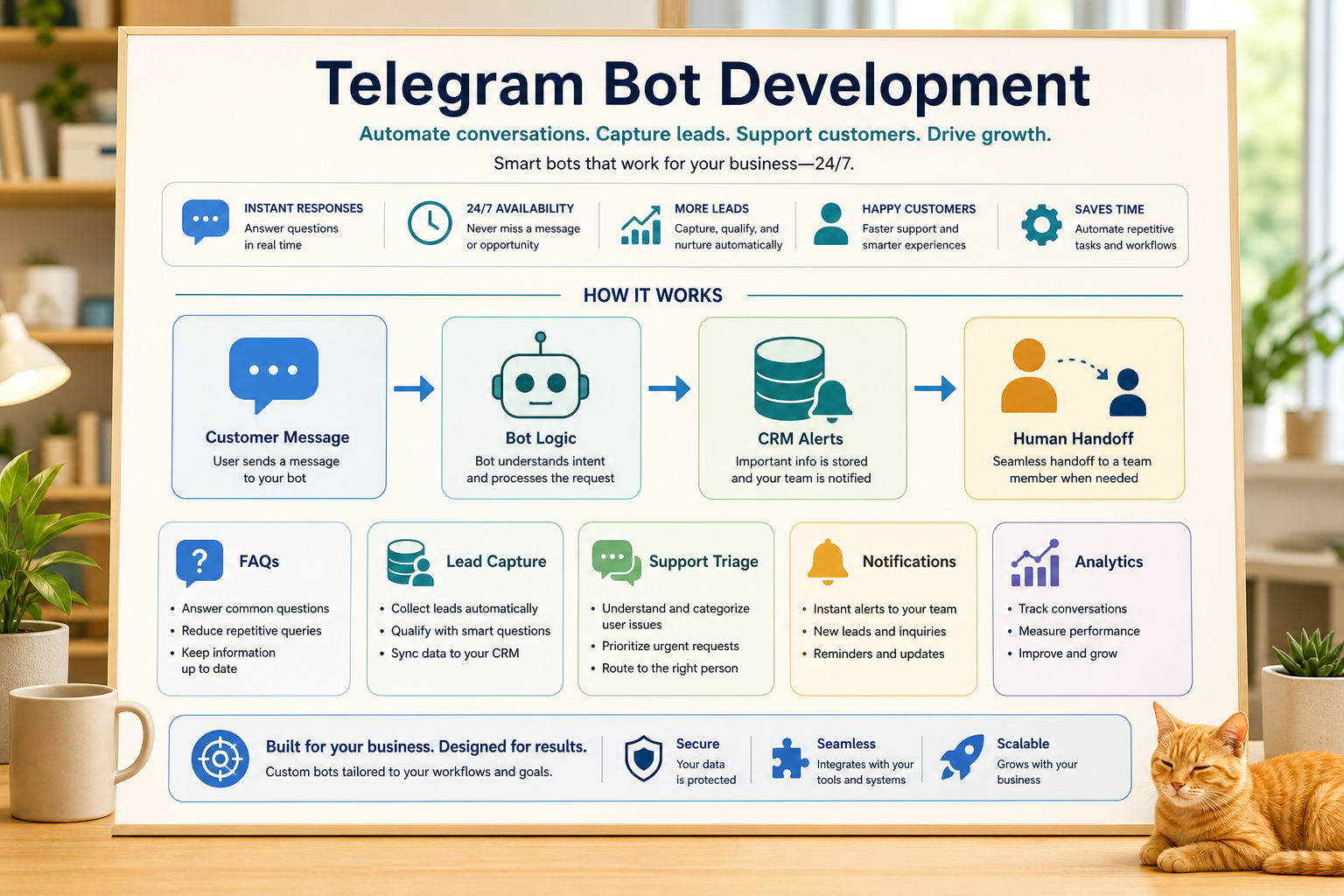
Cyberlife Development LLC’s Work Approach
We start with understanding the current workflow: how and where requests are received, where the data resides, and target points for automation, review, exception handling, and reporting. We configure the necessary tools, connect the required APIs, prepare the VPS or cloud environment as necessary, and create a handoff document so the system can be supported.
When to use this service
This page is relevant when support or creation of a specific technical system is needed. These systems automate business processes in such a way that they require fewer updates, generate reports automatically, simplify data transfers, or provide safe automation that continues to operate after it has been released and provides a commercial benefit.
Please refer to the most relevant, existing service page (ai-automation), or reach out to Cyberlife Development LLC directly with the most relevant automation request.
Why this page was created
Automation is probably the least popular product requested by the majority of IT service providers. The reason is that most employees do not want to work with a new system. They are only concerned with leaving the most frustrating tasks they've been forced to do. These tasks are routinely performed, and include, but are not limited to, the copying of leads from emails to CRM systems and the repeated exporting of documents for the same specific, unnervingly regular, reporting interval. These monotonous tasks may be menial, but they ultimately control the speed and responsiveness of the business.
This reality is the reason the majority of Telegram bot development requests are to automate the repetitive completion of business tasks. The most sensible question to ask is not whether the process to be automated is new or modern, but rather where the process is breaking the business the most and what would the answer to the process be if it were designed with the most thoughtful processes of the least burden on the business in mind.
For small businesses just starting to automate, it is best to start with a single, specific case and design an automation with definable completion and review steps. Only once a simple automation is built should the business expand its boundaries and attempt to add other automations.
Where the work typically begins
The goal of the first step is to draw a workflow map using plain language. Don’t stress about making it a perfect diagram. There are some difficult questions that can be answered by examining the diagram. What kicks off the process? What data is being presented and in what format? What system is used to manage the record? Who should be notified? How is the process considered to be complete? What should be done if something is out of order?
The main goal of automation is to eliminate steps in a process and remove confusion. If the workflow is defined, so will the automation be. If the team can’t agree on the passing of the baton, the software will move the confusion faster.
The workflow automation is simple. Write down the steps and remove the obsolete steps. When steps require human judgment, those need to be manually approved. The more simple, and clear the steps, the more automation can be implemented.
Workflows
Even though the steps might be different across companies, there are similar patterns. The receipt of a web form can create a record in a customer relationship management system (CRM), assign a user to the record, generate a first response email, and create a follow up task. Staff requests can be assigned, matched to the customer record, drafted and routed for review. A consolidated weekly email can be created to pull a summary from each of the other systems prior to the start of the meeting.
Document workflows are considered, along with others, a common first step in automation. Invoices, intake forms, PDFs, contracts, and even forms in a spreadsheet, can contain structured, though untidy, information. Fields can be extracted, files can be renamed, records can be updated, and questionable scenarios can be flagged for review.
This also applies to research workflows. Rather than having someone go and collect notes from a multitude of documents, emails, spreadsheets, and even chat threads, a workflow can do the collecting, do the structuring, and prepare a first draft for the person to review and use.
What should stay human
For an automation process, the best way to remain safe is to be honest about what cannot be automated. For example, judgment about pricing, customer interaction (which can be sensitive), legal and medical issues, and complaints, as well as vague documents, all involve a level of human discretion. This does not weaken the process. In fact, it strengthens it.
A workflow can also save time when it prepares the information, proposes the next step, and does so while obtaining the needed permission. This also encompasses the common failure of letting the system decide, the rationale of which the business cannot formally explain.
For many Cyberlife projects, the right process is "automate the prep, keep the approval." The system is extremely helpful when it summarizes the context, prepares a message, updates the records, and suggests an exception. It is still the responsibility of the person to decide if the situation justifies the automation.
Tool choices without tool devotion
Tools are important, but they are secondary to the workflow. Some projects are best served with simple connectors. Others may require n8n, Make, Zapier, Google Workspace, a CRM, a private database, a small custom API, or a combination of all of the above. Some may require a tool for classification, extraction, summarization, or writing, ranging from OpenAI, Anthropic Claude, Google's Gemini, or others. Some require a VPS, Docker, backups, monitoring, and logging because the workflow needs to run consistently without human supervision.
Selecting the wrong tool generally stems from starting the project with a platform demo rather than a business use case. There are instances when a tool appears sophisticated, but is not the best fit for the workflow. An easier, less time-consuming, and less sophisticated solution is preferred over a highly sophisticated and complex solution that no one in the team is willing to operate.
The criteria for evaluating Telegram bot development should include the ability to test the workflow, expose errors, the ability of the nontechnical owner to understand the handoff, and the ability of the business to modify the rules without having to redesign the workflow.
What to prepare before starting to build
Before building, be sure to gather some examples from the real world and, as best as you can, try to avoid the “perfect” examples. Leaving out the perfect example means using the messy email, the furloughed, filled, and even messy forms, the confusing spreadsheets, the invoice with some odd name, or that support ticket that starts the endless email thread.
Describe the expected output. This could be an update in the CRM, a dashboard, a task, a notification, a new file name, a reply, a report, or a review queue. The output must be clear enough for the team to assess whether it was accomplished.
Listing exception rules upfront is useful. When should the workflow be interrupted? When should an item be delegated to a person? What kind of information is private? What information needs to be logged? What information should never be sent without human oversight?
How to measure whether it worked
The best metrics are the simplest. Questions to consider include: Did the lead get a quicker response? Did the report arrive without manual edits? Did fewer support requests sit in the wrong inbox? Did the owner understand the difference without opening five tools? Did the team spend less time copying and more time making decisions?
Not every automation requires an in-depth ROI analysis. For small businesses, the first automation project is usually justified by the time savings and reduction in mistakes. The most important factor is to measure the effectiveness of the previous workflow, even if the measurement is not precise.
A good first automation project should automate a daily or weekly task that is easily recognizable and noticeable. If no one is able to tell the difference after the project, the project was probably too ambiguous.
The page should make the practical work clear: mapping the process, connecting the tools, handling exceptions, and leaving the business with a workflow that can be checked and maintained.
What the First Version Should Include
An effective first version should include a clear trigger, visible result, and evidence of failure. If the workflow is triggered by a certain form being filled out and submitted, the team needs to be informed about what happens to this record, who is responsible for it, what kind of notifications are triggered, and how and where exceptions are resolved. When reports are generated from multiple sources, the owner should be able to determine which of the sources failed instead of receiving a summary of the answer that is highly polished and incorrect.
This becomes more significant when AI is involved. AI is great at summarizing, classifying, extracting pieces, and even drafting. But the workflow that is in place around the AI needs to be verified as well. Inputs should be exemplified. Outputs should be reviewed. Action logs should be presented. If the model is ambiguous, the system should call for help instead of pretending.
Limit the number of pathways for your initial release. The automated edge cases on day one can end up being a bad and fragile build. Focus on the most common task runners, create a human review queue, and then develop the system after identifying real exceptions to the norm.
Automation Problems
Automation is failing. Simple things cause errors and you don't want your customer's experience ruined. A field name changes, a CRM owner is missing, a spreadsheet tab gets renamed, a vendor changes their invoice tab, and then an automation model makes an automation that is answer that is confident but does not match the account history. These are not reasons to avoid build automation, these are reasons to build automation that includes checks.
Good automation design has an automated fallback. If a step in an automation task fails, a notification is sent about the context. If data is missing and an automation task is to fill in the missing data, it will fail. If a task is to create an automation message to a customer and it is a sensitive message, a customer message automation task is created and the message will be saved as a draft for approval.
Having the ability to identify exceptions is the difference between having a demo and having a system that can actually be used in a business.
Knowing When to Get Help
As long as the method is clear, the tools to complete the method are already connected, and a team member is available to keep and maintain the system, basic internal automation is acceptable. However, crossing the workflow systems, using private data, implementing automation tasks and AI to interpret the data and tasks, and impacting sales, customer support, finance, or operations are all appropriate cases for getting help.
Cyberlife Development can outline the process, build the first iteration, and provide a sustainable process for the team. The first draft should not be a lengthy technical document. Instead, it should be a concise description of the process as it exists today and how it can be improved.
Bot and automation paths nearby
Telegram bot projects often connect to chat automation, n8n workflows, CRM lead capture, and internal operations.