
Workflow Automation Tools: N8n, Zapier, Make, and AI Workflows
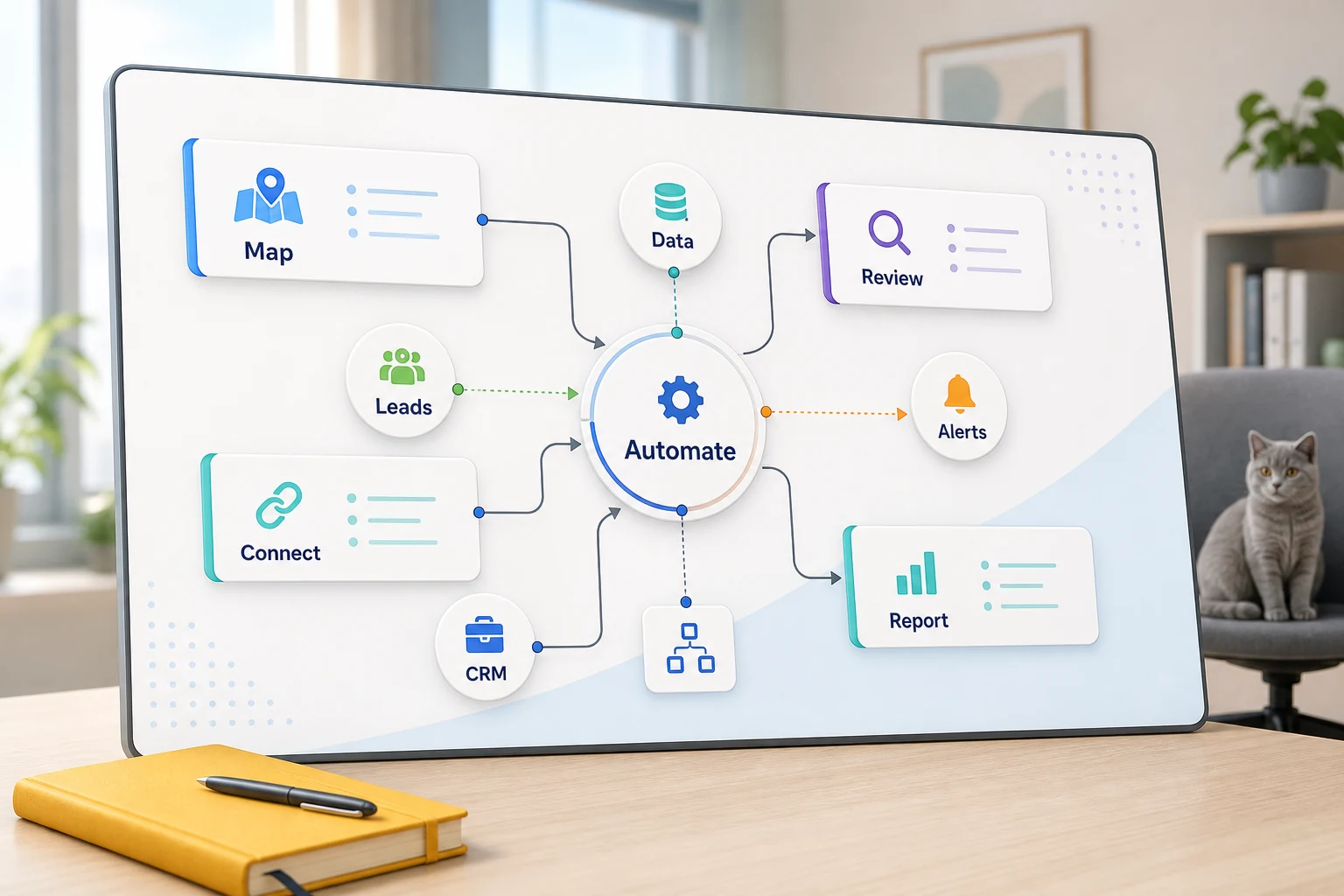
Workflow Automation with n8n, Zapier, Make, and AI Workflows
Choosing a workflow automation tool like n8n, Zapier, or Make is not purely a software question for most businesses. For many small businesses, the measure of a good automation tool is how fast it makes routine workflows, how easy n8n workflow automation becomes to review, and how little reliance there is on a person's memory.
This guide breaks down the practical considerations of automating workflows with AI. It explains the problems it can solve, the challenges that surfaces when trying to automate routine tasks, and how you can distinguish between basic automation tools, custom AI workflows, and paid, organized solutions.
Automation in Action
The most successful automation opportunities are usually tedious and routine tasks, and verifying their outcome is simple. These utilize the time between email communication, spreadsheet updates, CRM notes, invoicing, responses to a support inbox, form submissions on the website, research and reporting tasks.
using a form routing tool to add submissions to a CRM and assign an owner with an action step
replacing the time spent each week on clean up and manual spreadsheet updates with an automated dashboard or scheduled email reports
determining support requests that can be automated to a final step before review
using an automation tool to turn internal research from random notes to a brief
using workflow automating software to integrate OpenAI, Claude, Gemini, OpenRouter, n8n, Google Workspace, Slack, Telegram, and other services
Common search terms in this topic
Searching for this topic shows that people use the following phrases:
ai enhanced automated workflows
platforms for ai workflow automation
ai automation workflows software
ai tools for workflow automation
automated workflows for business process management
n8n process automation on github
Tool-first vs Workflow-first
A tool-first approach tries to fit a workflow within the limitations of a system. A workflow-first approach prioritizes the workflow steps; who the inputs and outputs are, what data is secure and how it is verified, what reviews are required, and what outputs confirm that the required work has been done.
This approach is built to remove steps. For Cyberlife projects, this means outlining the current system, identifying pieces that can be automated, and start small.
What to have prepared for the automation step
examples of what the current inputs look like (emails, forms, chat messages, CRM records, spreadsheets, files)
what the output should look like (notifications, a report, a task, a document, an updated CRM, a dashboard, or an alert)
Rules for exceptions and human review
Connection to the tools.
A brief success assessment showing time saved, fewer follow-up tasks missed, and/or quicker report submissions.
When custom workflows are advisable
The team can typically implement off-the-shelf tools for simple processes. Tools that are easily configurable may be necessary when workflows span across several systems, require AI, must be able to process private data, or need to be run in a server with monitoring and backups.
If you believe this is relevant to a workflow you have identified, refer to our AI automation services (/ai-automation/) page to see what we can do.
Addressing the real problem this page solves for you
No team wants to be drawn into a new platform. What they are looking for is a way for a time-consuming and frustrating process to be less of a pain. Eventually, someone copies and pastes all the lead information from an email into the customer relationship management (CRM) system. Someone exports the same metrics for the week. Someone makes sure a file was saved in the correct folder. Those things can be easily ignored, but ultimately they determine how quickly the company can respond to the market.
That is the real rationale for n8n workflows. Automation, genuinely is the next step, but the real purpose of automation is identifying the weak points in the processes, understanding who the stakeholders affected by the gaps are, and the ideal state of the process would be as safe and controlled as the placed steps.
For small businesses, the first iteration is often meant to be narrow. It is important to focus on one workflow, identify the appropriate trigger, and make some decisions regarding the trustworthiness of the data. It is also important to indicate the points of review and build your first version before you integrate additional tools and systems.
The place where the work starts
The first version of a workflow should be documented in plain language. It does not have to be a perfect diagram; however, a plain language workflow should answer the questions that may be most challenging to answer, such as: What is the starting point of the workflow? What data is received? Which application has the record? Who is notified if there is a record? What is the end point? What is the next step if there is an erroneous record?
This is the point where a project can gain value or become low quality and essentially worthless. If the description of the workflow lacks specifics, the automation performed to support the workflow will also lack specifics. If there is no agreement on the handoff, then the software will only make the confusion move faster.
The overall philosophy should be to move slow at the beginning and fast toward the end. Write the steps. Remove the steps that exist solely because a legacy tool has forced the creation of that step. Keep the steps where a human decision is required. Workflow the steps that are redundant and easy to verify.
Common workflows connected to this topic
Although business specific details determine automated processes, some trends are common. A case might come in through a website form, be logged in a CRM, be assigned to a rep, be sent an email, and have a follow-up task created. A support request might be segmented, matched to an account, created, and assigned. A data automation tool might create a report by gathering data from several applications and sending a concise summary an employee needs to be aware of prior to a scheduled meeting.
Document workflows are also common initial processes. Structured data might be dispersed, and messy data is in the form of an invoice, an intake form, a PDF, a contract, or in a row of a spreadsheet. Automation might capture fields, rename and classify files, update and create records, or flag the records to create cases for review.
Workflows associated with research can also benefit from automation. Instead of someone having to go through a spreadsheet, email, chat, and web resources to pull notes, a workflow could pull and organize the notes in the desired format, and generate a draft for the reviewer to finalize and submit.
What should stay human
The most successful automation projects are those that involve integrating promising new technologies to automate mundane tasks but require judicious oversight for the projects with the most serious ethical dilemmas. Pricing decisions, response to a sensitive or irate customer, for cases involving complex legal or medical issues, and automating processes to deal with less than blatant customer complaints usually require a human review or control error. These processes may not become completely automated, but they become invaluable and rewarding in the long run.
A workflow can do a lot. It can structure the data, formulate the next logical step in the process, and present the case for the user to give the go ahead. This is a substantial time savings, yes, but it also prevents the critical error of ceding control over an explained process the organization cannot otherwise account for.
For many Cyberlife projects, the optimal model is “automate preparation, retain approval.” The system knows how to collect and analyze context, draft messages, record updates, and explain exceptions. It is up to the user to determine when to pass final judgment.
Careful tool choice, no tool worship
Choosing the correct tool is essential, and so is building the correct workflow. Some projects only require simple integrations, while others necessitate n8n, Make, Zapier, Google Workspace, CRM integration, personal databases, or custom APIs. Others require the use of OpenAI, Claude, Gemini, or other tools for the classification and drafting. Some even require the use of a VPS, Docker, back ups, monitoring, and logging. This is because a workflow is only truly automated when it runs without user oversight.
The biggest mistake in tool choice is building a project around a demo rather than a concrete business problem. The most entertaining tools will always be the most dumb, and the dullest tools will always be the most intelligent. Something your staff can comprehend and that they are likely to use, is always a better option than an elaborate solution which no one will use
When implementing n8n, the first question to answer is: can this workflow be tested? Can we identify errors in the workflow? Can a non-technical business owner understand how work is passed from one person to another? Can the business implement a new rule without redoing the setup?
What to do before building
Gather some examples. Do not use perfect sample data. Use the messy email, the half-filled form, the confusing spreadsheet row, the invoice with a strange vendor name, or the support ticket that currently creates back-and-forth.
Define what results you expect. It could be a task, a file, a draft response, a CRM refresh, a notification, a report, a dash, a changed file, review thr queue, or a human assessment. Results should be precise enough for the team to determine if the goal is achieved.
It is a good idea to outline your exception criteria earlier rather than later. What would stop the process? What would be routed to a person? What is private? What should be logged? What should be sent automatically?
How to assess if your goals are met
Utilize reports with the metrics that matter most. Did the lead receive an improved response time? Did the report arrive without the need for prep? Did the support tickets sit in the wrong inbox for less time? Did the owner understand the reports without having to open five tools? Did the employees spend less time on administrative work?
Not every automation needs to have a return on investment model that is that detailed. Small or medium businesses can usually justify the first failed automation with the time saved with the removal of mistakes. The only thing that does matter is the time spent on the before automation compared to the time spent on the after automation, no matter how you choose to measure that.
When implementing your first automation, the goal should be to make a task that is completed on a daily or weekly basis, the goal should be to eliminate that time consuming task to the point that the employees get to automate it. If the employees do not notice that a task was eliminated, it is a sign that your goal was probably too ambitious.
A buyer comparing workflow automation platforms may also need to choose between n8n cloud, self-hosted n8n, and lighter hosted tools. AI workflow automation tools can help with classification and drafting, but n8n cloud pricing only matters after the team knows how many workflows, runs, and review steps it actually needs.
What problems are likely to occur
When talking about the problems that are likely to occur during the automation process, the failures are often pretty boring. Examples can include a field name being changed, an owner being missing from a CRM, a tab name being changed in a spreadsheet, a vendor changing their invoice format, or a model providing a confident but incorrect answer based on the history account. None of those should deter you from building the automation. They should instead be reasons for incorporating checks.
When designing automation, it is imperative to provide proper failsafes. If a certain step of the workflow fails, it should notify someone of the failure with enough context so that someone can fix the issue. If the step of the automation provides a customer-facing message, that message should remain a draft until it is approved. Rather than meeting the step's requirements by providing filler information, the workflow should halt and notify someone. A case is more likely to be a reason for not providing the automation rather than providing a justification for a lack of automation.
When to seek assistance
A simple internal automation is fine when the process is clear, the tools already connect cleanly, and someone on the team can maintain it. It is more advisable to seek assistance from third parties when the workflow connects several systems, uses internal private data, needs a higher level of unofficially provided reasoning through the automation, or when the draft contains a personal message. When a personal message is likely to be provided, the draft may contain the reasoning. When a message from an external organization is likely to be provided, the message will be placed in the draft.
Cyberlife Development is capable of mapping the workflow and building an initial version of the solution. Most importantly, they will leave the team with a solution they can maintain. The most useful starting point is not a lengthy technical brief. It is a concise description of the workflow which currently wastes time, how much time is wasted, and what the team would like to see happening instead.