
AI vs Automation
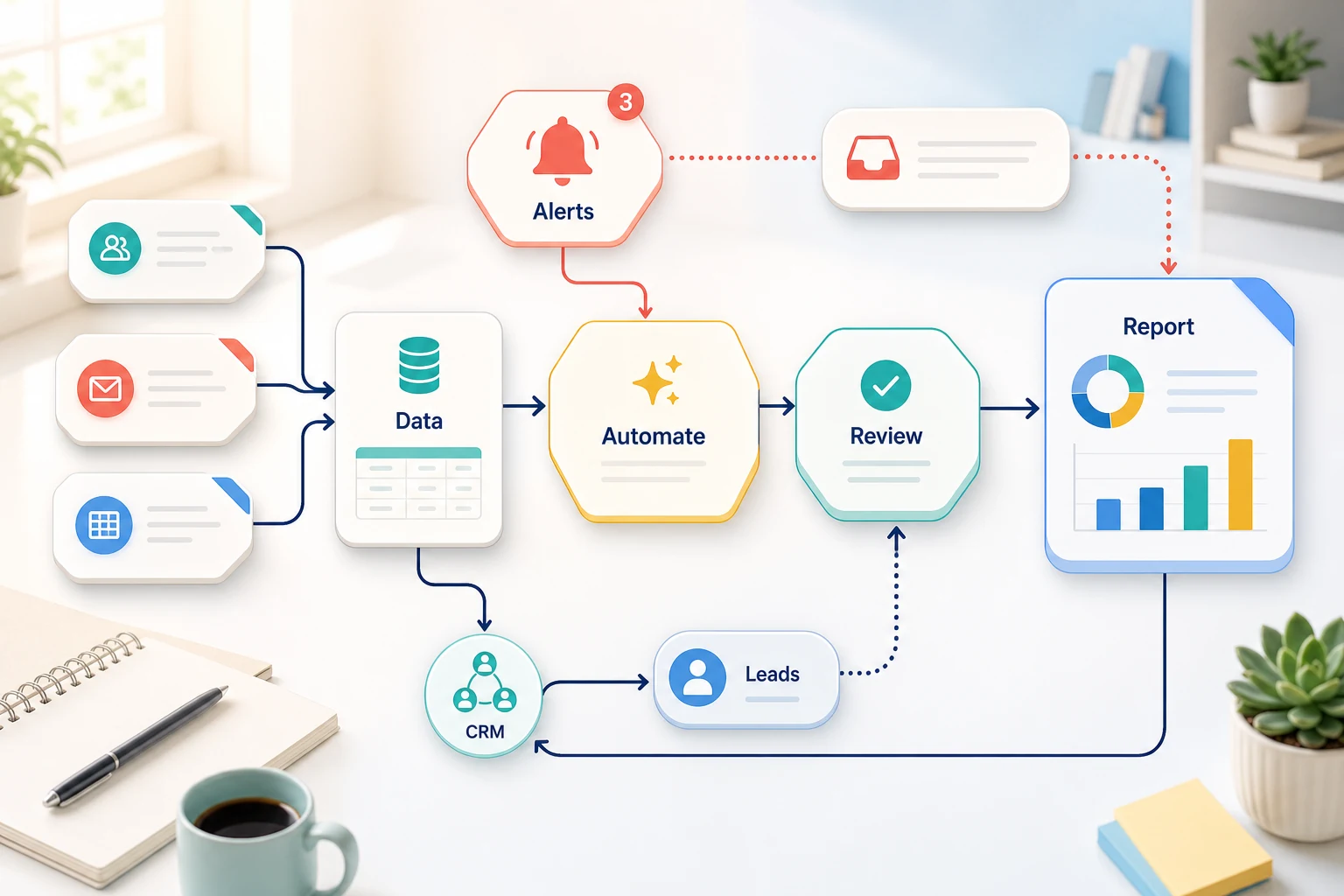
AI vs AUTOMATION goes beyond just software solutions. For a small business, this means understanding which of your repetitive workflows should be faster and easier to validate — plus less reliant on someone to remember each step.
This guide discusses how to navigate the AI vs automation dilemma, the types of problems AI can tackle, common automation pitfalls, and how to differentiate between simple no-code tools, bespoke AI automation, and a turnkey service.
Where this fits in a real business
You’ll most likely find your biggest automation ROI opportunities in repetitive, low-effort, low-friction, and easy to validate tasks. This is likely to be between your emails, spreadsheets, CRM notes, invoices, your support inbox, your website forms, research, and reporting tasks.
sending CRM submissions with an associated owner and a clear next step
transforming weekly excel tasks into an automated dashboard or email report
sorting support requests to improve case reviews and address edge cases
compiling internal or external research into briefs to improve document quality
bridging OpenAI, Claude, Gemini, OpenRouter, n8n, Google Workspace, Slack, Telegram, or a VPS-hosted workflow
Related keywords
The phrases that are searched most often in this area are phrased a bit differently. Useful keywords and related phrases include:
ai vs automation Which approach to take: tool-first vs workflow-first
A tool-first approach places a controlling feature or platform on the project, then tries to fit a workflow into it. A workflow-first approach starts with the handoff: who drafts, what data is trustworthy, what must be reviewed by an analyst, and what delivers proof the task was executed as planned.
For Cyberlife projects, this entails outlining the existing method, spotting the parts that can be automated with negligible risk, and crafting a basic implementation prior to an extensive rollout.
This avoids the risk of too much fancy automation with no net gain.
Requirements for a successful rollout
Samples of current inputs: forms, emails, spreadsheets, files, CRM data, chat messages
Anticipated outputs: reports, tasks, CRM updates, alerts, documents, and dashboards.
Guidelines for exceptions and reviews.
The integrated tools would need connections to the systems being integrated.
A quick assessment of success, such as measuring time saved, reporting fewer missed follow-ups, and improving reporting times.
Determining When to Use a Custom Setup
For simple processes, and where teams can manage the processes, off-the-shelf tools are appropriate. However, a custom setup is more appropriate if the workflow spans multiple systems, requires an AI to interpret it, requires sensitive data, and needs to be executed on a server with monitoring and backup.
If you find this topic is aligned with an operational workflow you would like to improve, you can find the other side of the implementation with our AI automation services (/ai-automation/).
What is this page really addressing?
Most teams are not excited for new platforms. They request new platforms as a replacement for the outdated part of their workflows. For example, the part of the workflow where someone is manually copying lead information from an email into a CRM, or someone is exporting the same numbers each week, and someone is checking if a document is saved to the correct folder. These tasks are often so small that they are ignored until it starts slowing down the responsiveness of the business.
This is the point of reference for AI as compared to traditional automation. The right question here is not about the appeal of automation because it is new. The right question here is, where is your workflow breaking? Who is feeling the most pain from the breaking point of the workflow? What will this workflow look like if the repetitive steps are automated?
For small businesses, it's usually best to keep the first version small. Choose one workflow. Set the trigger. Identify the most reliable data. Specify where someone needs to check the output. Finally, create the simplest version with the smallest possible solution before scaling up.
Where the work usually begins
A great starting point is a simple workflow that is easy to read. It doesn't have to be a perfect diagram. It's got to get to a few uncomfortable answers: What kicks off the process? What info is shared? What tool keeps the record? Who gets an alert? When does the process stop? What should go unaddressed?
This is where most of the effort of designing an automation either pays off or creates more work. If the workflow has no clear description, your automation will have no clear function. If there is confusion about who does what, the tool will do nothing but move confusion.
The most effective automation usually starts off slow and speeds up later. Write the steps, take out the ones that were added because of lack of flexibility in a previous tool, and keep the human authorization for steps that require discretion. Finally, automate the steps that a person has to do over and over again that require no judgment or discretion.
Common workflows associated with this topic
Your specific setup will depend on your business, but the basic workflow structure remains the same. For example, a web form submission can automatically create a record in your CRM, assign an owner, send an initial response, and create a follow-up task. A support request can be automatically classified, matched with the requester’s account information, and assigned to the appropriate person with a pre-populated request for review. A weekly report can be automatically crafted with a summary of the necessary data pulled from the various integrated tools before the Monday morning meeting.
Document workflow solutions are another common use case. Invoices, input forms, PDFs, contracts, and data entry forms are filled information that is often unstructured. Automation can extract fields, rename files, update records, and create cases for review. The unstructured fields are documented.
Research workflows can also be automated. Rather than having someone compile draft notes from disparate sites, spreadsheets, their email inbox, and chat threads, you can use a workflow to assemble and organize these inputs to create a draft.
What should remain human
The most reliable automation projects are clear and honest about where human involvement should remain. Price discretion, sensitive customer feedback, the exercise of professional discretion in legal and medical contexts, atypical complaints, and ambiguous documents will invariably require a human review. This does not undermine the value of the automation; in fact, it demonstrates the value-adding aspect of the automation.
In preparing the information and automating the logical step of requesting approval, a good workflow manages to avoid the most common shortcoming of good automation, which is allowing the workflow to make decisions that the business cannot justify and explain.
For many Cyberlife projects, the preferred model is "automate the prep, keep the approval." Systems train to pick up context, compose messages, maintain records, and indicate exceptions. Ultimately, the individual determines when and if a judgment is awarded.
Tool choices, no tool worship
Tools should complement workflows but not the other way around. Some projects need only simple connectivity. Others need n8n, Make, Zapier, Google Workspace, a CRM integration, a private database, or a small custom API. Some may even require the use of a model (such as OpenAI, Claude, or Gemini) for tasks like classification, extraction, summarization, or drafting. Others may need a VPS, Docker, backups, monitoring, and logs to ensure the workflow runs reliably without oversight.
A mismatched tool choice typically results from a platform-first approach instead of a workflow-first one. A tool can be visually appealing but still misaligned with the workflow. People prefer a simple, boring system to a complicated one.
When it comes to automation versus AI, a better checklist is, can the workflow be made testable to see if it is working, can mistakes be shown, is a handoff clear to a non-technical person, and does the business remain flexible to changes in policy and rules.
What to prepare before building
Come up with a few examples you may expect to see after implementation. Prefer examples that are far from being picked to be the benchmark of what you are building. These may include a messy email, a partially completed form, a non-logical order in a spreadsheet, an invoice with an unknown vendor, or a support ticket.
This then determines the desired outcome. The response could be an update to the CRM, a dashboard, a task, an alert, a renamed document, a templated response, a report, or a queue for human review. The direction needs to be detailed so the team can determine if the outcome is as intended.
Including the exception rules is also helpful. What is the desired outcome that would break the workflow? What would cause it to be redirected to a person? What information is considered private? What is the desired outcome that is to be considered for record keeping? What is the desired outcome that would break the workflow but is undesired to be sent on autopilot?
How to assess if it worked
The most effective metrics are the simplest. Did the lead receive a quicker response? Did the report arrive without the need for a laborious clean-up? Did the support requests spend less time in the undesirable destination inbox? Did the owner check without the need to open five tools to understand the report? Did the team spend less time on repetitive tasks and more time on goal-oriented tasks?
The return on investment for every automation should not be thoroughly assessed. For a small business, the time saved and the reduction of mistakes is usually the justification for the first effort. The important factor is to assess the flow of the old system before implementing the new one even if the assessment is not accurate.
An initial good automation should be able to simplify the execution of the same task on a daily or weekly basis. If the difference is imperceptible, the project is too abstract.
SEO and search terms for this topic
For this topic purpose, different people may phrase it as ai vs automation. The way people search is important, the content still should be targeted towards business owners and not use random keywords.
That explains why the final version must retain key phrases while describing the actual work, which includes: mapping the steps of the process, linking the tools, resolving exceptions, and delivering a solution to the business along with a verifiable workflow.
What Should Go in the First Version
The first version must achieve clarity in the cause, the effect and the ability to identify the cause of the failure. If the workflow is initiated via form submission, the process must make it clear to the team who or what form the record is assigned to, what notification is sent to the assignee, and how the exceptions are managed. If the workflow is initiated via multiple data sources, the owner of the workflow should be notified of the failed data source, and not be provided the erroneous final report.
This is more critical in the presence of workflows that integrate Artificial Intelligence. AI is highly capable of summarizing, classifying, extracting, and even firsthand drafting, but the workflow should be clear and verifiable as well. Inputs must not lack examples. Outputs must be subject to review. Processes must be clear and indicate what step was taken. If the AI is unsure, the system must ask for directives instead of going on with the presumptions.
The first version must also be free of excessive branching. On the face of it, automating every possible failure case may be tempting, but it usually creates an inflexible solution. A constructive option is to cover the highly used paths, and then increase the branching upon receipt of the review.
What can go wrong
Automation can be dull. One field changes. A CRM owner disappears. A vendor renames a file. A model records a confident answer but contradicts the account history. These do not imply one should avoid automation. Rather they indicate the need for more automation control.
Good automation design includes fallback behavior. If a step fails, the workflow should notify someone with enough context to fix it. If the data is incomplete, it should pause instead of filling in guesses. If a customer-facing message is sensitive, it should become a draft for approval.
Oftentimes, this is the distinction between a demo and a working business system. A demo is a happy path. The real system is ready for a messy Monday.
When to ask for help
A simple internal automation is great when the process is clear, the tools already connect cleanly, and someone on the team will maintain it. Custom help is more justified when the workflow crosses several systems, uses private data, needs AI to interpret it, or impacts sales, customer support, finance, or operations.
Cyberlife Development can map the first draft workflow, and leave the team with something they can maintain. The best starting point is a short description of the workflow that wastes time, and what could fill the gap.