
Best Marketing Automation Software for Small Business
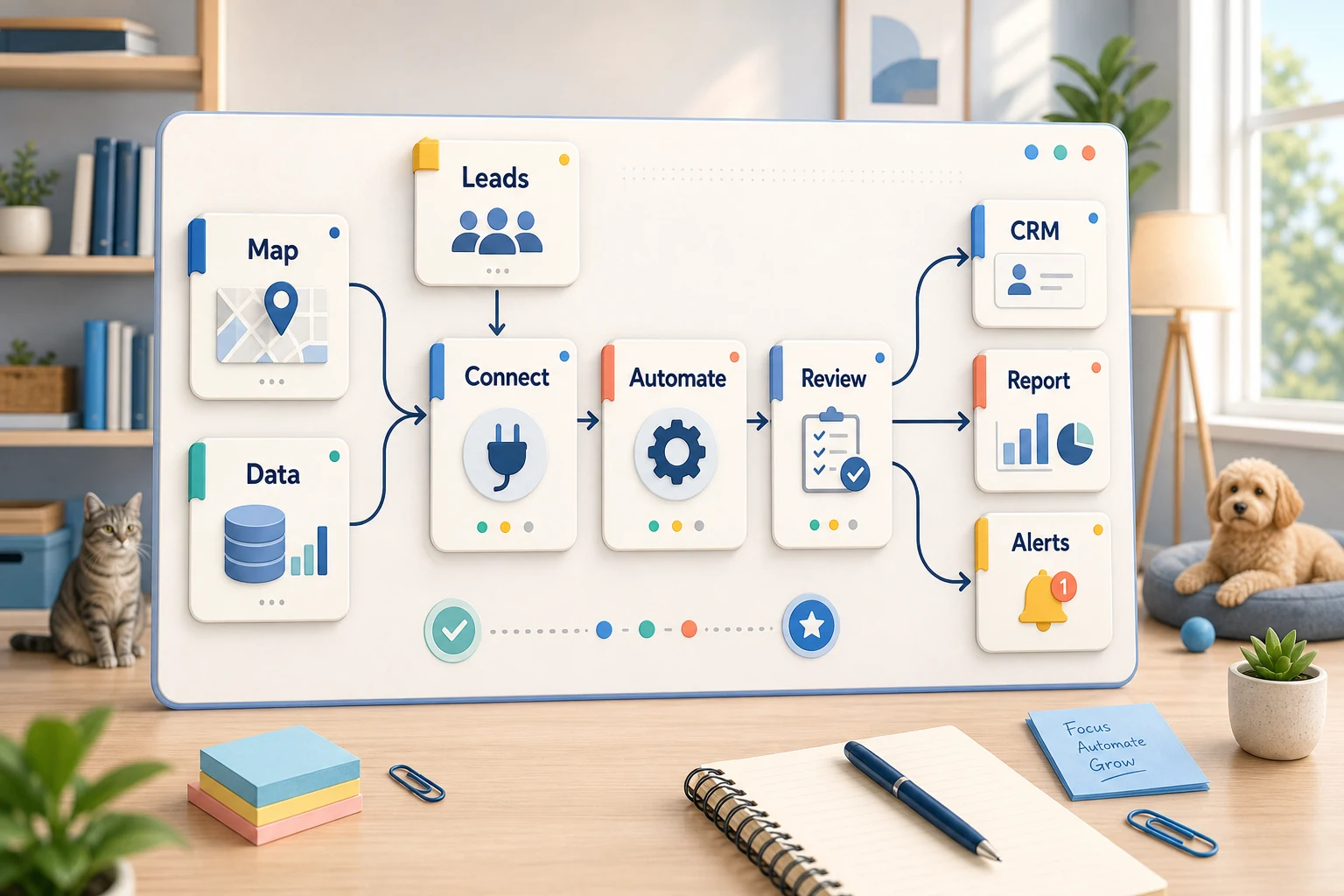
Finding the best marketing automation software for small businesses goes beyond a simple software search. For small businesses, the real question revolves around which recurring task can be streamlined, simplified, and made less reliant on the memory of a single individual to complete all the steps.
This guide will help you understand marketing automation software, the issues it can address, where automation is likely to break, and how to make a choice among simple tools, custom AI workflows, and a managed implementation.
Where this fits into a real business
The best opportunities for automation will likely be mundane, repetitive, and simple to verify. These opportunities will likely involve tasks related to email, spreadsheets, CRM notes, invoices, support inboxes, website forms, research tasks, and reporting routines.
submitting forms to a CRM with defined owner and next step
creating a dashboard or email report to perform back-end spreadsheet office work
sorting support requests to be handled without addressing edge case support requests
converting messy briefs to organized briefs based on public or private research
integrating OpenAI, Claude, Gemini, OpenRouter, n8n, Google Workspace, Slack, Telegram, or a VPS-hosted workflow when it is economically justified
Related Keywords
Searching for this topic yields various results. The relevant results contain:
preferred marketing automation software for small business Tool-first vs. Workflow-first Decisions
Opting for a tool ends up forcing workflows into the structure, however, when workflow comes first, it deals with the handoff, input, and trust data which requires human oversight as well as the intended output to illustrate the completion of the task.
In most Cyberlife projects, this comes down to observing the current state and determining the safe automation zones before building a minimum viable product. This is aimed at avoiding the automation trap of creating a pretty process that generates significantly more manual work.
What to have in place for execution
An example of what will be submitted to the system as input: forms, e-mails, spreadsheets, documents, CRM posts, chat messages.
An example of what will be produced as output: a report, task, CRM post, alert, a document, or a dashboard.
Clearly outline human intervention and review.
Enable automation by providing necessary integrations to the tools that need to be joined.
A quick success validation can be time and effort savings, fewer missed follow-ups, and quicker reports.
When Custom Setups are Useful
An off-the-shelf solution is sufficient when a task is straightforward and the team can handle it. A custom setup becomes worthwhile when the workflow spans multiple systems, demands AI explanation, necessitates the handling of confidential information, or must operate consistently using a server equipped with supervision and backups.
If this aligns with operational workflows you wish to enhance, please visit our marketing and social media automation page (/marketing-social-media-automation/) to see the implementation.
What This Page is About
Most teams don't want to overhaul the system. They want specific activities stopped from being fragile. Someone is copying lead information from an email to a CRM. Someone exports the same digits every Friday. Someone looks to see if a document is saved in the correct folder. However, these tasks seem small, possibly insignificant, until they develop a core function that dictates how fast the business can respond.
This is the most helpful way to determine what the best marketing automation software is for small businesses. The helpful question isn't, “So, automation. How modern?” The helpful question is, “Where do these processes break? Who is left holding the cleanup? What do we want safer to look like? The same repetitive steps with the same consistent workflow?”
The first version, as a rule of thumb, should be narrow for small businesses. Choose one workflow, then designate the trigger. Choose which data can be trusted. Choose the review checkpoints. Build the narrow version, then add integrations and automations.
Where Work Most Often Begins
Good first drafts are simple, text-based workflow maps. They don't need to be perfectly drawn, but should answer a series of tough questions: What kicks off the process? What data enters the process? Which system owns the data at the end of the process? Who is the recipient of the notification? What is the definition of the process being done? What do you expect to happen in the system when you notice something is out of the ordinary?
This is where automation projects become valuable vs. just additional work to be done. If the team are unclear on the process, the automation will reflect that. Similarly if the team are unclear on the handoff of the process, the software will reflect that.
The goal is to be slow at the start of the process, and fast at the end. Write the process as it is done today. Remove the steps that an old system forced. Keep the to be system in a process.
Common workflows connected to this topic
While the specific arrangements look different for each company, the general principles remain constant. A website form can be set up to create a CRM record, assign an owner, send the first reply, and create a follow-up task. A support request can be categorized, matched with account info, and drafted for routing to the appropriate reviewer. A weekly report can aggregate data from multiple tools and send a brief summary ahead of the Monday meeting.
Document workflows are another great place to begin automation. Invoices, intake forms, PDFs, contracts, and even the rows of a spreadsheet, can all contain structured data that is stuck in an unstructured, poor format. Automation can perform data extraction from fields, rename documents, update records, and can flag edge cases for review.
Research workflows can also benefit from automation. Instead of assigning a person to compile all the notes that were scattered across websites, spreadsheets, inboxes, and chat threads, a workflow can do the compiling, organize the notes, and even generate a first draft that needs a person to review and approve before use.
What should stay human
The most successful automation projects actually thrive in the areas that are the most honest about what should not be automated. Pricing, customer judgment, legal and medical decisions, extreme complaints, and documents that are vague and of a complex or ambiguous nature need a person to review them. That doesn’t make the automation bad. It makes it much more effective.
An automated workflow can gather and prepare the data and propose the next action, but requires a person to approve the workflow. This is a common failure that gives a business an automated system that can make decisions, but it is an unfounded business decision.
For many projects at Cyberlife, the design strategy is to “automate the prep, keep the approval.” The system is capable of collecting the context, drafting the message, updating the record, and presenting the exception. It is still up to the individual to judge if the situation requires discretion.
Tool choices without tool worship
While tools are important, they should not dictate the workflow. Some projects are compatible with basic connectors. Others will require one of n8n, Make, Zapier, Google Workspace, a CRM integration, a private database, or a small bespoke API. Some will require the use of certain models from OpenAI, Claude, Gemini, or others for purposes of classification, extraction, summarization, or drafting. Others will require a Virtual Private Server, Docker, backups, monitoring, and logs because the workflow has to run reliably without someone watching it.
Choosing the wrong tool tends to occur when the project is based around a platform demo instead of a business problem. A tool may appear to be great, but it can actually be a poor fit for the workflow. A boring setup that the team can understand is better than a poorly designed setup that the team cannot comprehend.
When assessing marketing automation software for small business, the better questions to consider are doing the workflow and assessing the system with the perspective of someone non-technical. Can the errors be seen? Can the system be explained to a non-technical person so that the business can change the rules later without starting from scratch?
What to prepare before building
Before you begin to implement, collect some real world examples. Avoid using sample data that is in perfect order. Use the messy email, filled in the form, the confusing row of a spreadsheet, the invoice with a strange vendor name, or the support ticket that currently creates back and forth.
Next, detail the expected output. This may be a change in the CRM, a dashboard, a task, a notification, a renamed file, a reply draft, a report, or a human review queue. The output must be clear enough for the team to determine the success of the workflow.
List the exception rules. What should terminate the workflow? What is to be diverted to a person? What data is to be kept private? What is to be kept in a recording? What is not to be sent without human intervention?
How to assess effectiveness
The best metrics are mundane. Did the lead receive an expedited response? Did the report come in without the need for cleanup? Did support requests receive less time in the wrong inbox? Did the recipient understand the changes without opening five programs? Did the team focus on less time, copying, and more on deciding?
Not every automation needs return on investment. For a small business, the time and error savings are often more than enough to justify a first project. The important part is to at least determine rough metrics on the productivity of the workflow that is to be automated, prior to that automation.
A good first automation should do a task that is done frequently on a daily or weekly basis, and make the task easier. If the task is not done frequently, the project was apparently too abstract.
SEO and search terms for this topic
People search for this topic using different keywords — for example, best marketing automation software for small business. We want to cater to search languages, but the content still needs to be written for a business owner, not a keyword sheet.
The practical work should stay clear: map the process, connect the tools, handle exceptions, and leave the business with a workflow that can be checked and maintained.
What the first version should include
The first useful version should show a clear cue and an apparent outcome, and define a way to measure failure. If filling the form launches the workflow, the team should know where the record will show up, who will be the case owner and what notification will be sent, and what will be the workflow exception. If the report is generated by multiple data sources, the case owner should be informed of the specific data source which resulted in the failure, and should not be presented with a sophisticated but erroneous final report.
This becomes more important with the presence of AI. AI can serve numerous purposes, like summarization and extraction, but it is imperative that we can test workflows around AI solutions. Inputs should be provided. Outputs should be analyzed. Logs should explain the context. If there is ambiguity in the model, the system should be designed to ask for clarification rather than making assumptions.
The first release should avoid too many branches. Automation on day one for every edge case creates builds that are difficult to work with. It is better to focus on the most common path the first time the feature is released, put exception path requests in a queue for manual review, and then work on automating the exception paths based on the exception paths business is observing.
Automation is quite boring and unpredictable. An invoice format can change, a field name can change, a tab in a spreadsheet can get renamed, the owner of a CRM can get deleted, the AI can generate a confident statement that an account does not support. These are all problems that will happen with automation. These are not problems with automation. These are problems that automation should be built with.
An automation should have fallback behavior. An incomplete field should not be filled with a guess, an automation should halt the process and wait for the next step. An automation should not send an incomplete customer facing message, it should be a draft.
Knowing what to do on a Monday is hard and that is the difference between a demo and an actual business tool. The demo is always the happy case.
Sometimes it is okay to make an internal automation as a personal project. It is always a better idea to get help to build an automation where you can integrate personal data outside the company. Automations that deal with personal data should be built by professionals.'
Cyberlife Development can outline the workflow, put together the first iteration and give the team a process that is sustainable. The best first step is not a lengthy document. It is a short description of the workflow that is currently wasting time and how it can be improved.
From software shortlist to working automation
Choosing the best marketing automation software for small business is only part of the project. The bigger gain comes from connecting forms, CRM records, email follow-ups, reporting, and lead scoring into one workflow. Cyberlife can help build that layer; see our AI marketing automation service.