
What Is Marketing Automation Platform?
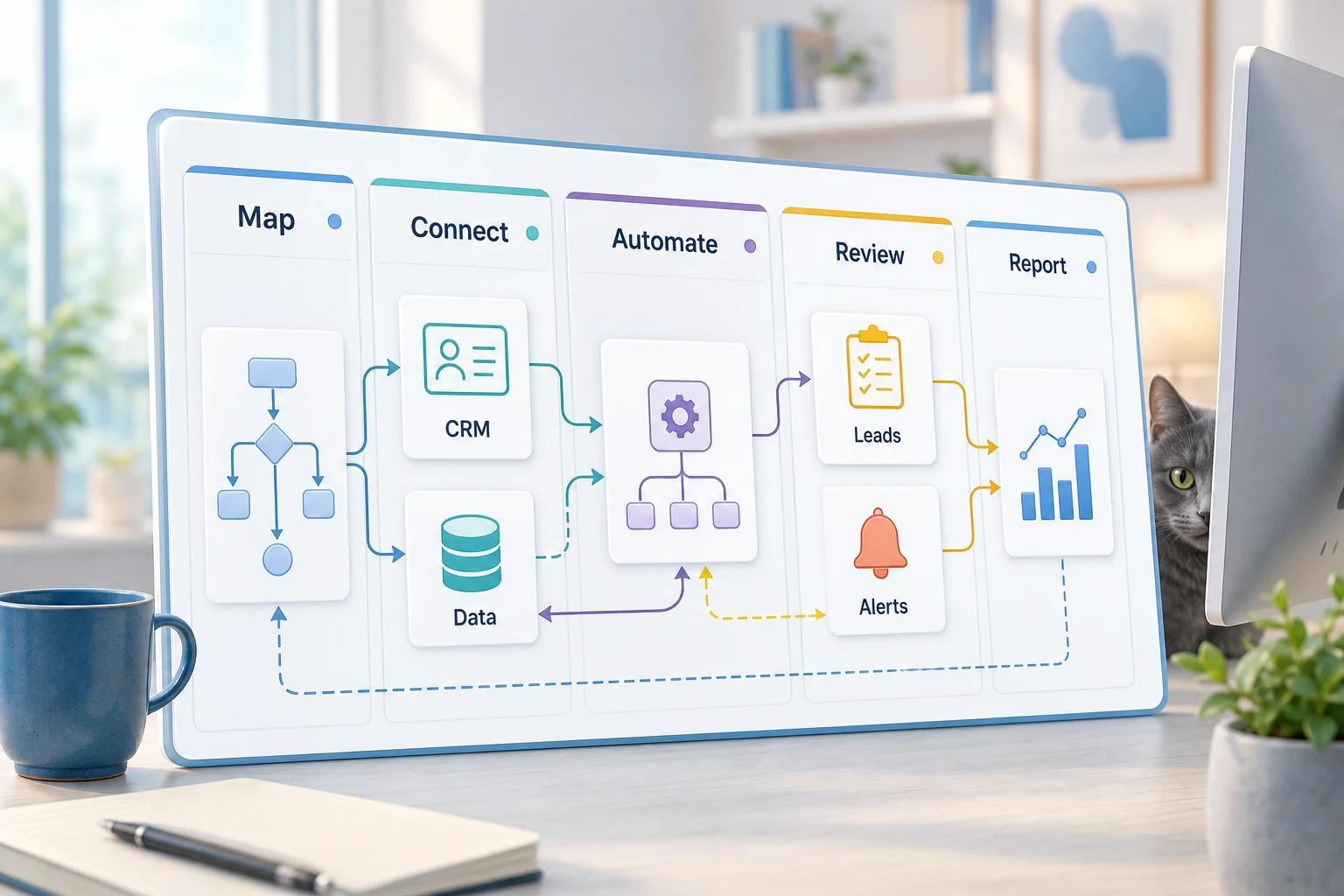
The question about what is a marketing automation platform extends beyond just asking about software. For a small business, it's about identifying the recurring workflow that can be automated to save time, make it easier to review, and lessen the dependence on a person remembering the steps to complete the tasks.
This guide outlines practical solutions to the question of what is a marketing automation platform, what problems can it potentially solve, where the gaps of automation can be found, and how to go about selecting a simple tool vs. building a custom AI workflow vs. purchasing a managed implementation.
Where This Fits in a Real Business
The areas that have the most opportunities for automation are tasks that are considered boring, repetitive, and easy to confirm. These tasks exist in between email, CRM notes, spreadsheets, invoices, support inboxes, website forms, research tasks, and reporting tasks.
Feeding form submissions into the CRM with automatic assignment of owner and next task.
Transforming the weekly spreadsheet work into a recurring dashboard or email report.
Automating the sorting of support requests while reserving human review for edge cases.
Consolidating both publicly available and internal research into a properly formatted brief rather than an unorganized document.
Seamlessly integrating various tools and platforms (OpenAI, Claude, Gemini, OpenRouter, n8n, Google Workspace, Slack, and Telegram) and a VPS for workflow automation where it makes the most sense for the business.
Typical Keyword Searches Related to This Topic
Some of the most common keyword searches surrounding this topic include:
What is a Marketing Automation Platform? Tool-First vs. Workflow-First Approach
A tool-first approach dictates that a platform defines the workflow. In contrast, a workflow-first approach starts with the term.
In the case of Cyberlife projects, this approach denotes mapping out the current state, defining the areas that can be automated along the process, developing, and finally scaling the process. This approach counteracts the automation trap.
What to Prepare for An Automation Project
Current state automation artifacts (forms, emails, spreadsheets, files, CRM, chats) examples.
The desired automation state (report, task, CRM update, alerts, documents, dashboards).
Guidelines for exceptions, who, and how the process will be reviewed.
The required connectivity for tools used.
A brief success evaluation, such as saved time, reduced missed follow-ups, or quicker report submission.
When custom configuration is appropriate
When a process is basic and can be easily managed by the team, standardized tools are adequate. However, when a workflow is distributed across multiple systems, involves AI interpretation, requires handling of sensitive information, or must run consistently on a server with monitoring and backups, a custom configuration is warranted.
If this topic is relevant to an operational workflow you wish to refine, check out our marketing and social media automation page (/marketing-social-media-automation/) to see how we implement it.
What this page is really about
Most teams do not want an entire new platform. Most teams want a certain part of their week to not be so fragile. An employee has to copy lead information from an email to the CRM system. A different employee has to export the same numbers every Friday. A third employee has to check if a certain document is saved in a certain location, and in a certain order. These tasks are all insignificant on their own, but when considered as a whole these tasks dictate the speed with which a business can operate.
Within a marketing automation platform, the relevant question is not how far we can modernize the process through automation. The relevant question is where the current workflow is interrupted, who is forced to manually intervene to resolve this disruption, and how can we ensure that the workflow is automated in a safe manner that is repeatable.
For small businesses, the first version is better off being narrow and small. When building one workflow, start with the trigger, the trusted data, and the result review. Only then should you build the smallest working version and incorporate additional systems.
Understanding Where to Begin
A good starting point is a simplified version of a workflow map. This does not have to be a perfect diagram, but should help answer what the steps will be, including what starts the process, what information is included, what tool is used to maintain the information, who is notified and what is considered complete, and what will happen if anything appears to be wrong.
Automation projects either become useful or simply fail to deliver. If the workflow is vague, the automation will be vague. If the team cannot agree on the handoff, software will only move the confusion faster.
Aim for a process that is slow to start and speeds up with repeat use. Beginning with a description of each process step, remove redundant steps. Keep any steps that involve a human judgment review, and automate anything that is redundant and simple.
Common workflows connected to this topic
The exact implementation varies, but certain patterns are consistent. A web form submission creates a CRM record with an owner, an initial response is sent, and a follow-up task is created. A support request is categorized, matched with account information, and a response is drafted and assigned to the appropriate person. A weekly summary report is automatically created with a data pull from multiple tools.
Document workflows are a common use case as well. Messy documents, invoices, intake forms, PDFs, contracts, and rows in a spreadsheet often contain structured data. Automation can extract data from these documents, rename and version them, update systems of record, and save them in uncertain cases.
Research workflows can also fit in this category. Instead of designating an employee to collect fragmented notes from various websites, spreadsheets, email, or instant message, a workflow can automate the gathering and structuring of notes and even generate a draft for the employee to review.
What should stay human
The most successful automation projects have a clear understanding of processes that should remain human. Pricing decisions, responses to raw emotions, legal and medical judgments, responses to unusual complaints, and the interpretation of vague documents typically require a human touch in order to remain effective. Having an automation project weigh the costs and benefits of a certain trade-off is a very effective design strategy.
A well-designed workflow can do the preparatory work, proffer an action step, and solicit approval, all of which saves time. It also addresses the prevalent automation failure of delegating the system to come up with an answer to a question that the business cannot rationally justify.
In many Cyberlife projects, we implement a design philosophy of “automate the prep, keep the approval.” This means the system is able to collect context, draft messages, update records, and present exceptions. However, the user still ultimately has the power to decide if the situation calls for their evaluation.
Tool selection vs. tool worship
Tools are important, but they should be secondary to the workflow. Some projects may only require a simple connector. Others may require n8n, Make, Zapier, Google Workspace, CRM integrations, private databases, or custom APIs. Others still may call for OpenAI, Claude, Gemini, or similar tools for classification, extraction, and draft generation. Finally, some projects may justify the use of a VPS, Docker, backups, and monitoring.
The most common way to select the wrong tool is starting from a platform demo and not from a business problem. Showcasing an impressive tool does not mean it is a good fit for the workflow. A simple understanding by the team (and therefore use) trumps an advanced build that is not used.
When evaluating a marketing automation platform, the best checklist is: can users test the workflow, see errors, guide users through the process, and will the business be able to modify the rules without starting from the beginning.
What to do before building
Prior to building, it is important to gather examples of actual scenarios. Make sure the examples are imperfect. Collect a messy email, partially filled forms, or confusing tabular data. Include invoices with nondescript vendor names, and support tickets requiring unnecessary back-and-forth communication.
Next, describe what you want the output to be. An example output could be an update in the CRM, a task, a notification, a report a dashboard, a response in draft form, a rename of a file, a report, or a queue for a human to review. The team should be able to say whether or not the task was successful based on the output you think defines success.
It is beneficial to provide some guidelines to quickly identify some exceptions. What is the criteria that stops a certain workflow? What is the criteria that a workflow is sent to someone? What data is private? What is the criteria that causes a workflow to log? What is the criteria that a workflow is sent without user intervention?
Evaluating Automation
Filling out a simple form and submitting a ticket is a perfect example to determine the success of an automation implementation. Did the lead get a faster response? Did the report arrive without manual cleanup? Did support requests sit in the wrong inbox? Did the owner know what changed without opening five tools? Did the team report less time on copying tasks, and more on time on strategic decision making?
If this is a new automation project for a small business, there is no doubt a time savings would justify the new initiative, however, there should be an effort to put a measure of the old project to compare against once the new project is complete.
A simple routine task that the team sees a visible improvement in is a great candidate for an initial automation project. If the team does not perceive any improvement, it was likely a poor choice for an initial project.
SEO
What is marketing automation platform? The exact search terms used may affect the response, but leading keyword based content is still not the goal. The content should read as it was written for a business owner.
The practical work should stay clear: map the process, connect the tools, handle exceptions, and leave the business with a workflow that can be checked and maintained.
What the First Version Should Contain
The first version is effective if it has a distinct trigger, visible results, and a failsafe system. For example, when the workflow is initiated by a form submission, the team should know the process for record disposition, for ownership determination, for the issuance of an alert, and for exception management. If a report is generated by multiple data sources, the report owner should know which data source was the cause of the report rather than relying on a report that was generated with multiple errors.
This is more important when involving the use of AI. AI can summarize text, classify data, extract elements, and employ drafting, but the workflow that is involved with it still needs to have tests. Inputs should be based on guidelines. Outputs should be validated. Data should be clear on what was executed. If a model is uncertain, the system should ask for clarification instead of answering.
The first version should also avoid creating too many branches. The first version should be based on the most common path, then the business can expand the workflow after it observes true exceptions.
What can go wrong
Automation is boring because of all the little things that can go wrong. These things include but aren't limited to changes in field names, missing CRM owners, renamed spreadsheet tabs, invoices formatted differently by a vendor, and models that confidently respond with answers that are not consistent with the account history. These things should not give you pause with implementing automation. They should give reason to design various checks within automation.
Designing automation provides for fallback behavior. Workflows will inform the automation checks with context for the automation gaps that will be needed to fill in order to keep the workflow moving. Customer messages containing sensitive information will become drafts.
The difference between the demo and the working business system is that the real system shows the working business system on a messy Monday.
When to ask for help
When the process is clearly defined, the tools connect neatly, and workflow automation can be easily maintained by an internal employee, implementing simple internal automation is perfectly fine. The right path will be to utilize external help for a lot more complex systems. These systems include the use of private data, AI-based interpretation, and systems that will be tied to sales, customer support, finance, operations and the like.
Cyberlife Development can build the first version of the workflow, map it, and give the team a process that can really be maintained. The right starting point will be the mapping of a workflow which costs a lot of time that should not be the case, along with a brief as to what should really happen.